USB-C PD 3.1 Explained: What Is Extended Power Range (EPR)? (2026 Guide)
Fast charging technology continues to evolve in 2026. Many users are confused about
PD 3.1 vs Intel GaN and how these technologies improve charging speed, efficiency, and safety.
In this guide, we explain the difference between USB Power Delivery 3.1 and GaN-based chargers,
and which one is better for laptops, smartphones, and high-power devices.
⚡ What Is PD 3.1?
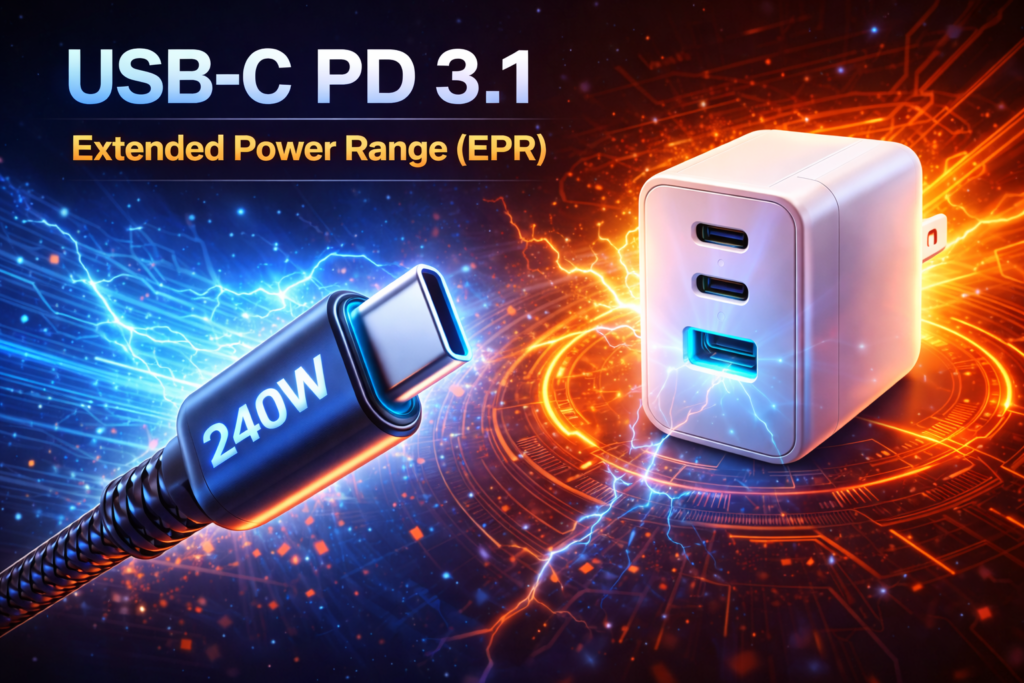
PD 3.1 (USB Power Delivery 3.1) is the latest USB-C fast charging standard
that supports up to 240W power output. It enables fast charging for laptops,
gaming devices, and high-performance electronics.
Learn more about USB Power Delivery on
Wikipedia.
For a detailed breakdown, read:
PD 3.0 vs PD 3.1: What’s the Real Difference?
🔥 What Is Intel GaN?
GaN (Gallium Nitride) is a semiconductor material that replaces traditional silicon.
GaN chargers are smaller, more efficient, and generate less heat compared to standard chargers.
If you’re unsure whether GaN is worth it, check:
Are GaN Chargers Better Than Normal Chargers?
📊 PD 3.1 vs Intel GaN: Key Differences
| Feature | PD 3.1 | GaN Technology |
|---|---|---|
| Main Purpose | Power Delivery Standard | Charger Material Technology |
| Max Power | Up to 240W | Depends on PD support |
| Efficiency | High | Very High |
| Heat Management | Standard | Improved Cooling |
🏆 Which One Should You Choose in 2026?
The best option is actually a PD 3.1 GaN charger.
PD 3.1 controls power delivery, while GaN improves efficiency and reduces size.
See our recommendations:
Best GaN Fast Chargers in 2026
❓ Frequently Asked Questions (FAQ)
Is PD 3.1 better than GaN?
No. PD 3.1 is a charging standard, while GaN is a semiconductor technology.
They work together, not against each other.
Do I need PD 3.1 for my laptop?
If your laptop requires more than 100W charging, PD 3.1 is recommended.
Modern MacBook Pro models benefit from higher wattage.
Are GaN chargers safer?
Yes. GaN chargers generally produce less heat and offer improved thermal management.
Can I use a GaN charger without PD 3.1?
Yes, but maximum performance requires both GaN technology and PD 3.1 support.
Final Verdict
In the debate of PD 3.1 vs Intel GaN, the real winner is combining both technologies.
Choose a high-quality GaN charger with PD 3.1 support for maximum speed,
efficiency, and future-proof charging in 2026.