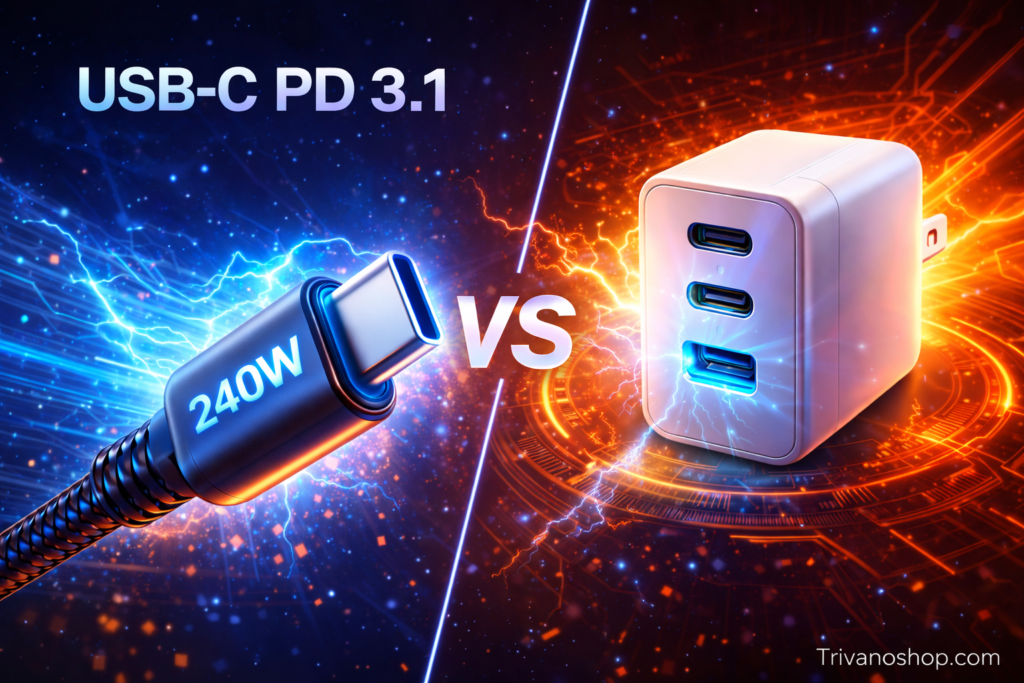
The discussion around PD 3.1 vs Intel GaN has intensified in 2026 as charging technology continues to evolve rapidly. With more laptops supporting 140W charging and USB-C cables now rated up to 240W, many consumers are confused about whether they should prioritize USB-C PD 3.1 or choose a GaN-based charger.
To clarify the confusion, it’s essential to understand that PD 3.1 vs Intel GaN is not a direct competition between two identical technologies. Instead, these technologies operate at different layers of the charging ecosystem. PD 3.1 defines how power is delivered, while GaN determines how efficiently that power is converted inside the charger.
Understanding USB-C PD 3.1
USB Power Delivery 3.1 (PD 3.1) is the latest revision of the USB-C Power Delivery specification. It introduces Extended Power Range (EPR), allowing power output up to 240W — significantly higher than the 100W limit of PD 3.0.
PD 3.1 expands voltage profiles to include:
- 28V
- 36V
- 48V
These new voltage levels enable high-performance devices such as gaming laptops and workstations to charge via USB-C.
For a deeper technical explanation of the protocol, see:
USB Power Delivery Technical Overview
You can also read our detailed comparison:
PD 3.0 vs PD 3.1 – What’s the Real Difference?
What Is Intel GaN Technology?
Intel GaN refers to chargers built using Gallium Nitride semiconductor materials. GaN replaces traditional silicon transistors with a more efficient material that can operate at higher frequencies with lower energy loss.
In the PD 3.1 vs Intel GaN comparison, GaN does not define power levels — instead, it improves efficiency, reduces heat, and enables smaller charger designs.
For more details on GaN technology:
Gallium Nitride – Wikipedia
You may also find this helpful:
Are GaN Chargers Better Than Normal Chargers?
PD 3.1 vs Intel GaN: Core Technical Differences
When analyzing PD 3.1 vs Intel GaN, it is important to separate protocol from hardware material.
| Category | PD 3.1 | Intel GaN |
|---|---|---|
| Type | Charging Standard | Semiconductor Technology |
| Maximum Output | Up to 240W | Depends on PD implementation |
| Main Benefit | Higher voltage support | Smaller size & higher efficiency |
| Heat Efficiency | Protocol-based regulation | Lower heat generation |
How PD 3.1 and GaN Work Together
The most advanced chargers in 2026 combine both technologies. A charger may use GaN internally to improve efficiency while supporting PD 3.1 to deliver up to 140W or 240W safely.
This means the best answer in the PD 3.1 vs Intel GaN debate is often: choose a charger that supports both.
If you’re shopping for high-watt chargers, see:
Best GaN Fast Chargers in 2026
Performance & Efficiency Comparison
Silicon-based chargers typically operate at lower switching frequencies, resulting in larger transformers and more heat. GaN-based chargers operate at higher frequencies, allowing smaller components and reduced thermal output.
PD 3.1 complements this by ensuring that high voltages (such as 48V) are negotiated safely between the device and charger.
Together, they offer:
- Faster charging for high-end laptops
- Better thermal management
- Improved portability
- Future-proof charging support
Real-World Use Cases in 2026
For Smartphones
Most smartphones do not require PD 3.1. Even flagship phones typically draw between 20W and 45W.
For Ultrabooks
A 65W or 100W PD charger is usually sufficient.
For Gaming Laptops
Here, PD 3.1 becomes more relevant, especially for 140W charging support.
Is PD 3.1 Necessary Today?
In the PD 3.1 vs Intel GaN analysis, necessity depends on device requirements. Most users do not need 240W charging unless their device specifically supports it.
However, investing in a GaN charger with PD 3.1 support ensures long-term compatibility.
Safety Considerations
USB-C PD 3.1 includes intelligent voltage negotiation to prevent overcurrent or overheating. GaN technology further enhances safety by reducing internal heat generation.
Safety always depends on:
- Certified cables
- Reputable brands
- Proper voltage matching
Frequently Asked Questions (FAQ)
Is PD 3.1 better than Intel GaN?
They serve different purposes. PD 3.1 manages power delivery standards, while Intel GaN improves hardware efficiency.
Do I need PD 3.1 for 140W charging?
Yes. 140W charging requires PD 3.1 support.
Are GaN chargers more efficient?
Yes. GaN chargers typically waste less energy as heat.
Can a charger support GaN without PD 3.1?
Yes. GaN describes internal material technology, not power negotiation standards.
What is the best option in 2026?
A certified GaN charger with PD 3.1 support offers the best combination of performance, efficiency, and future compatibility.
Final Verdict
The PD 3.1 vs Intel GaN comparison is not about choosing one over the other. PD 3.1 enables higher power output, while Intel GaN improves efficiency and compact design. In 2026, the smartest choice is a GaN-based charger that supports USB-C PD 3.1.