USB connectors are an essential part of modern technology. From smartphones and laptops to chargers and accessories, USB cables are used every day by millions of people. Despite their widespread use, many users do not fully understand the differences between USB connector types, especially USB-A and USB-C.
USB-C vs USB-A
This article provides a clear and detailed explanation of USB-A and USB-C. You will learn how they work, how they differ, and why USB-C is becoming the standard for modern devices.
If you plan to switch to USB-C, check our guide to modern USB-C charging solutions.
Understanding USB Technology
USB stands for Universal Serial Bus. It was created to simplify the connection between computers and electronic devices. Over the years, USB technology has evolved to support faster data transfer, higher power delivery, and better compatibility.
As devices became more advanced, older USB connectors began to show limitations. This led to the development of newer connector types such as USB-C.
What Is USB-A?
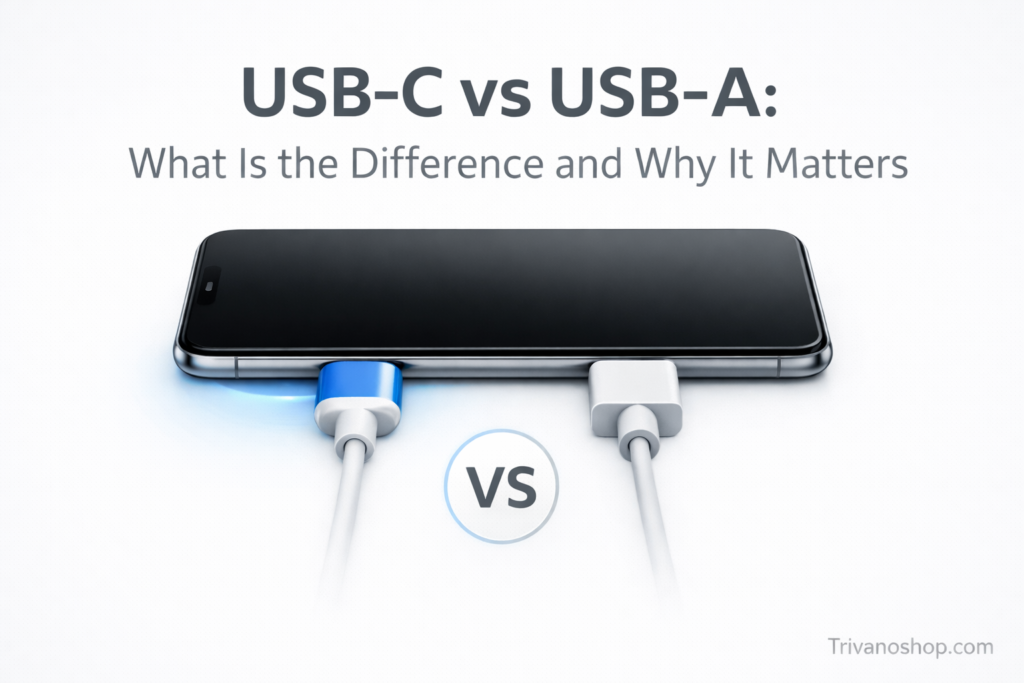
USB-A is the most familiar USB connector. It has a rectangular shape and has been used for many years in computers, wall chargers, power banks, and other accessories.
One common issue with USB-A is that it can only be inserted in one direction. Many users have experienced frustration when trying to plug it in correctly.
USB-A connectors support basic charging and data transfer, but their capabilities depend on the USB version they are paired with.
Limitations of USB-A
While USB-A is still widely used, it has several limitations. It does not support very high power delivery and is not designed for modern fast charging standards.
USB-A also lacks flexibility. It cannot transmit video signals easily and is not suitable for advanced multifunction connections.
What Is USB-C?
USB-C is a newer and more advanced USB connector. It has a small, oval-shaped design and can be plugged in either direction, making it much more user-friendly.
USB-C was designed to be a universal connector that supports charging, data transfer, video output, and audio through a single cable.
Advantages of USB-C
One of the biggest advantages of USB-C is its ability to deliver higher power. This allows smartphones, tablets, and even laptops to charge faster and more efficiently.
USB-C also supports faster data transfer speeds compared to USB-A. This is especially useful for transferring large files or connecting external storage devices.
Additionally, USB-C can carry video signals, allowing users to connect monitors and displays using a single cable.
Charging Differences Between USB-C and USB-A
Charging performance is one of the main reasons USB-C is preferred over USB-A. USB-C supports modern fast charging technologies that allow devices to draw more power safely.
USB-A charging speeds are generally slower and depend heavily on the charger and cable used.
Data Transfer Capabilities
USB-C supports newer USB standards that allow for significantly higher data transfer speeds. This makes it ideal for professional and everyday use.
USB-A can still transfer data, but it is often limited by older standards and slower speeds.
Compatibility and Everyday Use
USB-A remains widely compatible with older devices and accessories. Many users still rely on USB-A for keyboards, mice, and legacy equipment.
USB-C is becoming standard on modern smartphones, laptops, and tablets. Many manufacturers are gradually phasing out USB-A in favor of USB-C.
Safety and Reliability
Both USB-A and USB-C are safe when used correctly. However, USB-C includes smarter power management features that help protect devices from overheating and overcharging.
Using certified cables and chargers is important for both connector types to ensure safe operation.
According to
Wikipedia
, USB-C was designed to replace older USB connectors and support future technologies through a single universal standard.
Which One Should You Choose?
USB-C is the better choice for modern devices due to its speed, power delivery, and versatility. It is ideal for users who want faster charging and better performance.
USB-A is still useful for older devices and accessories. Many users will continue to use both types during the transition period.
Conclusion
USB-C and USB-A both play important roles in modern technology. While USB-A remains common, USB-C represents the future of connectivity. Understanding the differences between these connectors helps users make better decisions when choosing cables, chargers, and devices.